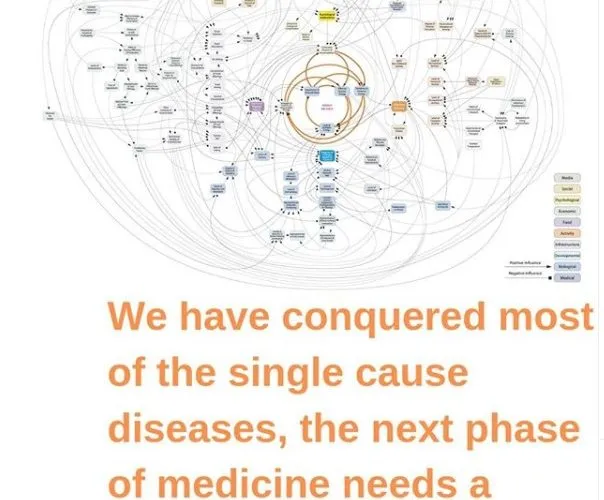
The failure to develop a magic-bullet drug that safely promotes weight loss is itself evidence: a reductionist, single-biologic-mechanism explanation is unlikely to account for the obesity epidemic. This is a complex system failure, and complex systems do not fail for one reason.
The numbers that frame it
In the United States, 52.3% of the adult population has either type 2 diabetes or prediabetes. Fewer than 12.2% were metabolically healthy in 2009–2016, and fewer than 7% are on the criteria applied after 2021. Six feedings a day is a recipe for insulin resistance. Those three facts together describe an environment, not a collection of individual failures of willpower.
Duality of interest
Pharmaceutical influence is so pervasive in academic policy and among thought leaders that recommending a product from a company that compensated the recommender is no longer reliably treated as a conflict of interest — it is softened into a duality of interest. The euphemism is doing real work.
The relationship is measurable: the more money physicians receive, the more brand-name drugs they tend to prescribe. When the recommendation is to reverse type 2 diabetes, hyperinsulinemia and obesity, the advice points toward less medical intervention and more patient self-care — which nobody is funded to promote.
Prescription medication as a cause of death
Prescription medications are now the third most common cause of death globally, after heart disease and cancer. That statistic is alarming on its face and it is not disputed by the bodies best positioned to know — the Academy of Medical Royal Colleges and the BMJ have published a blueprint aimed at reducing it.
How long change takes
It took nearly fifty years from the first published evidence linking smoking to lung cancer until effective regulation curbed tobacco consumption. Big tobacco’s playbook during that period is well documented and has been reused. Max Planck’s observation applies: science progresses one funeral at a time.
Breaking news that is not new
A study published in Obesity reporting that lifestyle interventions altering diet and physical activity through behavioural strategies can produce sustained weight loss is presented as news. It is not new. What is notable is which findings get amplified and which do not, and that tracks funding more closely than novelty.
The clinician’s own metabolic health
Overweight or obese physicians were less likely to discuss weight with heavy patients: only 18% did so, against 30% of normal-weight physicians. That is not an argument for judging clinicians. It is an argument for recognising that the same environment acts on the people delivering care, and that a system in which most clinicians are themselves metabolically unwell will not correct itself by exhortation.